Game Mechanics
Cat Puzzle Games and Timing Mechanics

Puzzle and timing games look like they belong in different categories, and they sit together because improving at either one requires the same thing: understanding exactly what is being measured. In a puzzle it is what you know. In a timing game it is when you act. Practising the wrong one wastes your time.
Two kinds of challenge
| Knowledge challenge | Execution challenge | |
|---|---|---|
| The question | What should I do? | Can I do it at the right moment? |
| How you improve | Learn, encode, recall | Repeat until the timing is automatic |
| Does thinking longer help? | Yes | No |
| Does the game wait? | Usually | No |
| Example | Cat Memory Match | Cat Obstacle Rush |
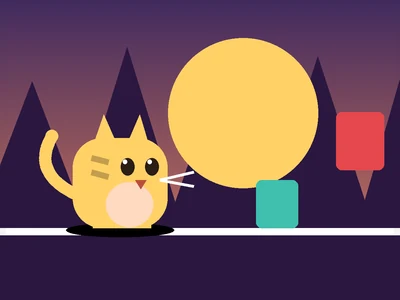
Most games in this category mix the two. Cat Obstacle Rush is half and half: identifying the pattern is knowledge, and executing the jump-slide sequence is timing. Which half is failing you determines what to work on, and it is usually obvious once you ask the question - if you knew what to do and did it late, that is execution.
How memory games are built
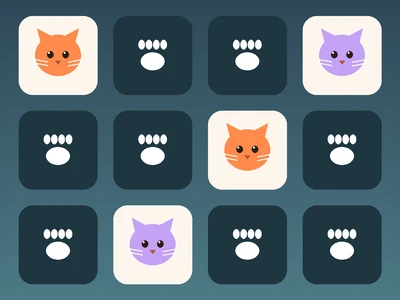
A pairs game is a search problem with a memory constraint. There are N hidden values, you may inspect two at a time, and you are scored on how many inspections you need. Play optimally and you remember every card you have seen; play at random and you re-reveal the same unknowns repeatedly.
The reason the larger board is meaningfully harder is not that there are more cards but that twelve pairs exceeds what most people hold in working memory at once. Below that threshold you can brute-force it with recall alone. Above it you need a method.
The method that works
- Sweep in a fixed orderWork left to right, row by row, on your first pass. Random flipping produces a scattered, unreliable mental map; a systematic sweep produces an organised one.
- Encode position with the picture'Orange tabby, row two, third from the left' is remembered far more reliably than the tabby alone. Say it internally - it feels artificial for about a minute and then becomes automatic.
- Flip the unknown card firstWhen you know where one half of a pair is, turn the unknown one first. If it does not match, you have still learned something new. Turning the known card first teaches you nothing on a miss.
- Use the flip-back pauseThe brief delay before non-matching cards turn over is your only chance to encode them. Clicking straight on to the next flip skips it, which is why fast play produces worse move counts.
How sequence games are built
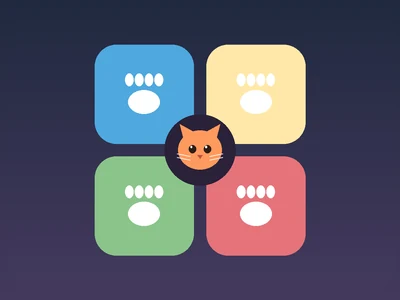
A sequence game asks you to hold an ordered list that grows by one each round. The list itself is trivial - four possible values - but ordered recall of a growing string is a genuinely limited human capacity, and the game is built to sit right at that limit.
Two design choices make a large difference to how it feels.
- Giving each element a distinct tone. This is not decoration. A four-tone sequence arrives as a short melody, and melodies are held far more reliably than lists of positions. Playing Cat Paw Pattern with sound on is meaningfully easier than with it off, and that is by design.
- Replaying from the beginning each round. The early steps get reinforced constantly while the newest step is heard once. That is why the last element is the fragile one, and why the right thing to do the moment playback ends is to fix the final pad in mind.
The technique that helps most is chunking - grouping the sequence into units of about three and recalling the units rather than the individual steps. It is the standard approach to holding longer strings in working memory, and in practice it is worth several rounds.
What makes a timing window fair
A timing challenge asks you to act inside a window. Whether that feels fair or arbitrary comes down to four properties.
- It must be visible
- You have to be able to see the window opening. A hazard that becomes dangerous with no visual change is a guess, not a challenge.
- It must be long enough
- Human reaction to a clear visual signal is a substantial fraction of a second. A window shorter than that cannot be reacted to at all - it can only be anticipated, which is a different and much harder skill.
- It must be consistent
- The same situation must produce the same window every time. A window that varies randomly cannot be learned, and learning is the only route to improvement.
- It should be forgiving at the edges
- Well-built games extend the window slightly beyond what is strictly correct - coyote time in a platformer is exactly this. It corrects for the gap between deciding and moving, and it is invisible when it works.
Cat Paw Pattern is instructive here because it has no timing pressure on your input at all. The game waits indefinitely for your reply. All the pressure is invented by the player, which is worth knowing, because pressing slowly and deliberately costs nothing and removes most of the slip errors that end runs past round ten.
Practising each kind
- For knowledge
- Slow down. Study the thing you are trying to learn deliberately rather than encountering it repeatedly at speed. Pausing on a pattern you keep failing is the fastest available route to solving it.
- For execution
- Repeat in cheap conditions. Drill the input where failing costs nothing, not in the hardest part of the run. Skills learned under maximum pressure transfer badly; skills drilled in safety transfer fine.
The most common error is treating a knowledge problem as an execution problem. Players who fail the same obstacle pattern twenty times are usually not failing to execute - they are failing to identify what the pattern requires, and twenty more attempts will not fix that. Pausing and looking at it once will.
A note on claims about memory
You will find plenty of sites claiming that memory games improve your memory. We do not make that claim. Establishing something like that properly requires research we have not done, and repeating an unsourced version of it would be worse than saying nothing.
What we can say is narrower and actually useful: the techniques described here - systematic searching, chunking, encoding position with picture - reliably improve your results in these particular games. Whether that extends to anything outside them is a question we are not in a position to answer.
Key Takeaways
- Work out whether you are failing on knowledge or execution - the fix is completely different.
- In pairs games, sweep systematically, encode position with picture, and flip the unknown card first.
- In sequence games, use the tones and chunk in threes; the newest step is the fragile one.
- A fair timing window is visible, longer than human reaction time, consistent, and slightly forgiving at the edges.
- Practise knowledge by slowing down and studying; practise execution by drilling where failure is cheap.
Frequently Asked Questions
Do memory games improve your memory?
We make no claim about that. The techniques here improve your results in these games; whether anything transfers further is a research question we have not investigated.
Why is the larger memory board so much harder?
Twelve pairs is past what most people hold in working memory at once, so recall alone stops being enough and a search method becomes necessary.
Why does sound make the sequence game easier?
Each pad has its own tone, so the pattern arrives as a melody. Melodies are held far more reliably than lists of positions.
What is chunking?
Grouping items into small units and remembering the units rather than the individual items. Recalling four groups of three is considerably easier than recalling twelve separate steps.
Is there a time limit on my answer in Cat Paw Pattern?
No. The game waits indefinitely. Any pressure you feel while replying is self-imposed, and pressing slowly reduces slip errors at no cost.
How do I stop failing the same obstacle pattern?
Stop repeating it. Pause when it appears and look at where the safe route is. Repeated failure on one pattern is almost always a knowledge problem wearing an execution costume.