
Game Mechanics
One-Tap Cat Games Explained
One button should be trivial. Here is why the best one-button games are not, and how they get depth from a single input.
One-Tap Arcade
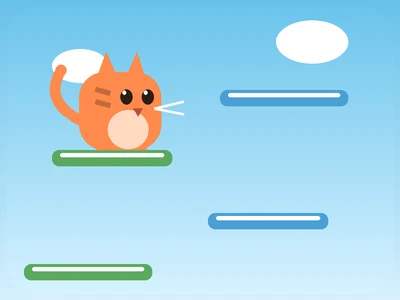
Cat Hop strips a runner down to a single input. The cat moves forward on its own across floating blocks; you press once to jump and hold slightly longer to jump further. Everything else is timing.
Score0
Best0
Press Start Game to play.
Cat Hop has exactly one input. Press and hold to charge a jump; release to hop. There is no move key, no second button and no menu to learn. Everything the game asks of you is contained in the length of a single press, which is what makes it the easiest game here to start and one of the hardest to master.
The cat crosses a line of floating blocks separated by gaps of varying width. A short press produces a short hop, a long press a long one, and the charge meter under the cat shows exactly where you are in that range. Overshooting is just as fatal as undershooting - the blocks have edges on both sides - so the game is not about pressing harder, it is about pressing for the right length of time.
Gap widths are generated within a range the engine guarantees is clearable, and the spread of that range widens as your score rises. Early gaps sit in a comfortable middle band. Later ones include both very short hops and near-maximum leaps, so you can no longer rely on a default press length.
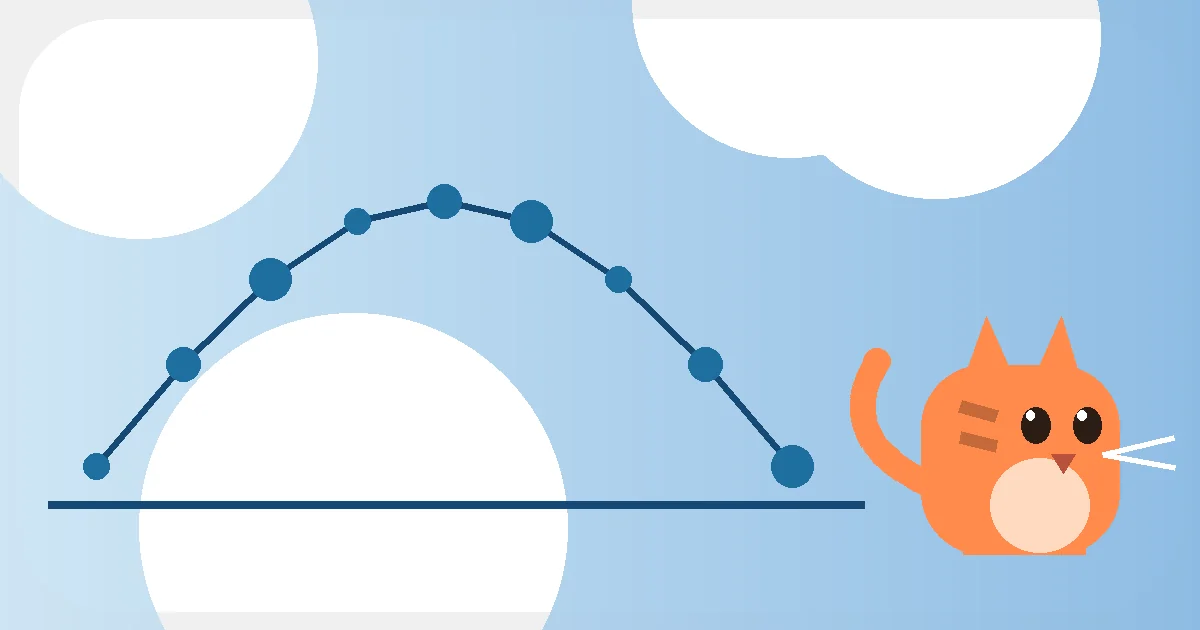
Coins sit on the natural arc of a correct jump. They are worth points, but their more useful function is as a visual guide: if you are flying over the coin, you are charging too long. Landing on the centre stripe of a block awards a perfect-landing bonus and a small sound cue, which gives you immediate feedback on accuracy rather than just on survival.
| Device | Controls |
|---|---|
| Desktop | Hold Space or click to charge a jump, release to hop |
| Mobile & tablet | Hold anywhere on the canvas, release to hop |
| Everywhere | Pause with the Pause button or the P key. Restart at any time with the Restart button. |
Advertisement
For your first few runs, deliberately watch the charge meter rather than the gap. Learn what a quarter, half and three-quarter meter looks like as a distance. Once those three lengths are in your hands, almost every gap in the game is one of them or something between two of them.
If you must be wrong, be wrong on the near side. Landing on the front edge of a block still counts, and it sets up a slightly longer next jump that you can see coming. Overshooting sends you past the block entirely with no recovery.
Perfect landings feel good and encourage you to speed up. Resist that. The game does not reward fast presses - the cat waits patiently on the block for as long as you like, so there is never a reason to rush a charge.
Before pressing, find the coin between you and the next block. Its horizontal position tells you roughly where the peak of the correct jump is, which is a much more reliable target than judging the far edge of a block.
Two maximum-length gaps back to back are the most common run-ender, because the second one arrives while you are still congratulating yourself on the first. When you clear a big jump, pause on the block for a moment and look at what is next.
Yes. Space, a mouse click or a touch all do the same thing, and there is no other input in the game.
By how long you hold. The charge meter under the cat shows your current power; releasing fires the jump at that power.
No. The generator caps gap width below the distance of a maximum-power jump, with a margin. Every gap in the game is clearable.
Landing within the centre stripe of a block. It awards bonus points and plays a distinct sound so you get feedback without looking at the score.
Up to the maximum. Once the meter is full, holding longer changes nothing - the jump fires at full power when you release.
No. Cat Dash has fixed-height jumps and obstacles to duck; Cat Hop has variable-distance jumps and gaps to cross. They test different skills despite both being one-handed runners.
Game Mechanics
One button should be trivial. Here is why the best one-button games are not, and how they get depth from a single input.
Tips & Strategy
One button, and still a real skill ceiling. These are the five things that raise it.
Tips & Strategy
Playing more improves you slowly. Practising a specific thing improves you quickly. Here is the difference.

