Puzzle
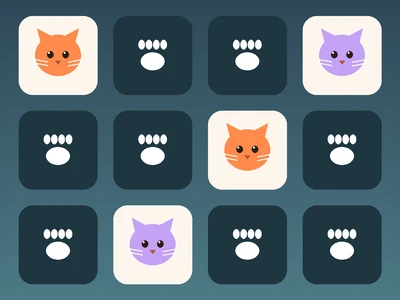
Cat Memory Match
Flip cards, remember where each cat face was, and clear the board in as few moves as possible.
Category
Games that ask you to remember, recognise and time rather than simply react.
This category covers two related things: genuine puzzles, where the answer is something you work out or recall, and skill games, where the answer is obvious but executing it is not. They sit together because both reward deliberate thinking in a way that pure reflex games do not.
Two of the games here have no fail state at all. Two of them are among the most demanding things on the site. The range is intentional - 'puzzle' does not have to mean 'gentle'.
5 games. Every one is playable now.
Puzzle
Flip cards, remember where each cat face was, and clear the board in as few moves as possible.
Puzzle
Watch the paws light up, then repeat the sequence back - one step longer each round.
Skill
Jump, slide and survive obstacle patterns that repeat just long enough to learn.
Advertisement
Where each part of this category is covered on the site.
The distinction is worth making because it tells you how to improve. In a puzzle, getting better means knowing more - a route, a pattern, a card position. In a skill game, getting better means executing more reliably something you already understand. Most of the games here are a mix, and the mix determines whether practice or study is the better use of your time.
| Game | Mostly puzzle | Mostly skill | How to improve |
|---|---|---|---|
| Cat Memory Match | Yes | No | Search systematically; encode card positions |
| Cat Paw Pattern | Yes | No | Chunk the sequence; use the tones |
| Cat Obstacle Rush | Half | Half | Learn patterns, then drill the inputs |
| Fish Collector | Half | Half | Plan two catches ahead; hold the centre |
| Cat Chase | No | Yes | Commit to lane changes earlier |
Both memory games here are built around a well-established property of working memory: people hold roughly four to seven separate items at once, but they hold far more when those items are grouped. Cat Paw Pattern becomes dramatically easier when you group the sequence into chunks of three, and Cat Memory Match becomes easier when you encode a card as a position-plus-picture rather than a picture alone.
Neither of these is a claim that playing the games improves your memory in general - that is a much larger question than a browser game can answer. They are simply techniques that make these particular games go better. There is more on this in cat puzzle game strategies.
Cat Memory Match has no timer pressure and no fail state, and Fish Collector cannot be lost - crabs cost you a multiplier, not a round. If you want something to play that does not end abruptly, those two are the ones to open. The short-session guide covers which games suit which amount of free time.
A game where the challenge is working something out or remembering it, rather than reacting quickly. Cat Memory Match and Cat Paw Pattern are the clearest examples on this site.
Because they reward deliberate thought rather than pure reflex - learning a pattern, planning a route, choosing a priority. We would rather group by how you improve than by a strict genre label.
Cat Memory Match has no fail state at all, and Fish Collector ends only when its sixty-second timer runs out. Neither can be lost in the usual sense.
It follows the same well-known format - watch a growing light-and-sound sequence and repeat it. The implementation, artwork and audio are original to this site.
Very well. Both memory games need only single taps with no timing pressure, which is the input touch screens handle best.
We make no claim about that. They are games, and getting better at them mostly means getting better at them. Any broader effect would need proper research, which we have not done and would not invent.
Game Mechanics
Two kinds of challenge sit side by side in this category: knowing something, and doing something at the right moment.
Tips & Strategy
Four techniques that reliably improve memory game results, and one claim we are not going to make.
Tips & Strategy
Raw reaction time is largely fixed. Nearly everything else that makes you fast is not.