Tips & Strategy
How to Improve Reaction Time in Arcade Games

Plenty of sites will tell you that games train your reflexes. We are not going to make that claim - establishing it properly needs research we have not done. What we can describe is narrower and more useful: what makes a player effectively faster in a specific game, and how much of that is reaction at all.
What "reaction time" is made of
The gap between something appearing and your finger moving has several parts, and only one of them is fixed.
- Detection - noticing that something changed. Heavily affected by where you are looking.
- Recognition - working out what it is. Falls dramatically with familiarity.
- Decision - choosing a response. Can be reduced almost to zero by pre-deciding.
- Execution - the physical movement. Largely fixed.
Only the last one is a biological limit. The first three are all shaped by habit and knowledge, and they make up most of the total, which is why players improve enormously without getting physically faster.
Detection: look where the information is
Something appearing in your central vision is noticed considerably sooner than something appearing at the edge of your visual field. So looking at the region where obstacles enter is worth more than any amount of reflex training.
In a runner, that is the right edge of the screen. In a collection game, the top of the play area. In a lane game, the furthest visible obstacle row. Most players look at their own character, which is the one place nothing new ever happens.
Recognition: familiarity is speed
The first time you see an obstacle you have to work out what it is. The fiftieth time, you know from its outline before you have consciously looked at it. That difference is large and it is available to anyone through repetition.
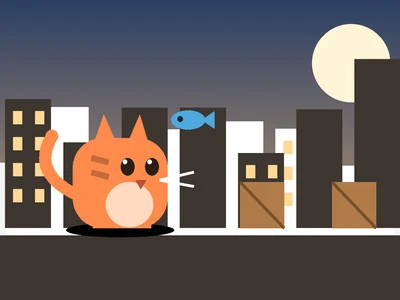
You can accelerate it deliberately. Learn the visual distinction between obstacle types - in Cat Dash, solid brown on the floor means jump and striped above head height means duck - and the recognition step collapses to almost nothing.
Decision: decide in advance
The slowest possible approach is to see an obstacle, consider your options and pick one. The fastest is to have already decided what you do in that situation, so that recognition triggers the response directly.
This is what practice actually produces. A well-drilled response is a single unit - see the shape, act - rather than a chain of steps. It is also why pre-deciding a policy ("if I am unsure, I duck") makes you faster: the decision has already been made before the situation arrives.
Anticipation: skipping reaction entirely
Past a certain speed, the window becomes shorter than a reaction cycle and responding to what you see stops working. Skilled players are not reacting at that point - they are predicting.
- From spacing
- Runners enforce a minimum gap derived from the current speed. Once you feel that rhythm, the next obstacle's arrival is predictable within a narrow range.
- From patterns
- In a pattern-based runner, the opening obstacle identifies the whole sequence. You then execute from memory, which is far faster than reacting.
- From the game's structure
- Knowing that a particular obstacle type only appears after a certain distance tells you what to expect before you see anything.
Things that genuinely help
- Turn the sound on. Audio cues register slightly faster than visual ones and use a separate channel, so they add information without competing for your eyes.
- Reduce stimulus uncertainty. The fewer possible things that can happen, the faster you respond to any of them. Learning a game's obstacle set narrows the possibilities.
- Stay relaxed. Tension slows movement. Gripping the keyboard harder does not make the press arrive sooner.
- Stop when tired. Fatigue slows every stage of the chain, and it does not recover within a session.
Things that do not
Trying harder, in the sense of concentrating more intensely, mostly produces tension. Playing for longer past the point of fatigue makes you slower. And chasing a faster mouse or display helps by a margin far smaller than simply looking in the right place.
Key Takeaways
- Reaction time is detection, recognition, decision and execution - only the last is largely fixed.
- Looking where new information enters is the single biggest improvement available.
- Familiarity collapses the recognition step, and pre-deciding collapses the decision step.
- Above a certain speed, good players anticipate from spacing and patterns rather than reacting.
- Sound helps, tension hurts, and fatigue slows every stage at once.
Frequently Asked Questions
Do arcade games improve your reaction time?
We make no claim about that. This article is about performing better in a specific game, which is a narrower and answerable question.
Why do I plateau at the same score?
Usually where the reaction window drops past what reaction alone can cover. Getting further means anticipating rather than reacting faster.
Does a high refresh rate display help?
A little, by shortening the delay before you see a change. It is a much smaller effect than where you are looking.
Is it better to react or to memorise?
Memorise wherever the game allows it. Recall is substantially faster than reaction, which is why pattern-based games reward learning so heavily.
Does caffeine help?
Not something we are qualified to comment on, and not something we would assert without evidence.