Game Design
Cat-Themed Browser Game Ideas

If you are building a small browser game, the hardest part is usually finding an idea small enough to finish. These are ten that fit in a weekend or two, with the thing that would make each one difficult stated honestly.
1. Cat and the falling shelf
Objects fall from a shelf; the cat is trying to push them off. Score for objects pushed, fail if one lands on you. Core mechanic: position and timing. Hard part: making pushing feel deliberate rather than accidental.
2. Yarn maze
A single continuous line the cat draws while moving; you cannot cross your own yarn. Core mechanic: space management. Hard part: collision against a growing path without it becoming slow or unfair at the head of the line.
3. Window ledge balance
A cat on a narrow ledge; tilt inputs push it left and right and it must stay on. Core mechanic: continuous correction. Hard part: tuning the instability so it is demanding without feeling random.
4. Nap defender
A sleeping cat; things approach that would wake it and you deflect them. Core mechanic: reaction under increasing rate. Hard part: making the threat legible early enough at high speeds.
5. Box stacker
Cardboard boxes drop and stack; the cat sits on top and the tower must not topple. Core mechanic: placement judgement. Hard part: physics that feels fair - a tower collapsing from an invisible cause is infuriating.
6. Shadow chase
A laser pointer dot moves in a pattern and the cat must be on it when it stops. Core mechanic: prediction rather than reaction. Hard part: making the pattern learnable but not trivially so.
7. Two-cat co-operation
Two cats controlled by different keys, both needed to reach the exit. Core mechanic: divided attention. Hard part: level design that is hard because of the division rather than because of the individual jumps.
8. Rooftop courier
Deliver an item across rooftops within a time limit, choosing your own route. Core mechanic: route optimisation under pressure. Hard part: making multiple routes genuinely viable rather than one being obviously best.
9. Sound sleeper
An audio-led game: the cat reacts to sounds you cannot see the source of. Core mechanic: listening. Hard part: it excludes anyone playing muted or with hearing difficulties, so it needs a visual equivalent that does not trivialise it.
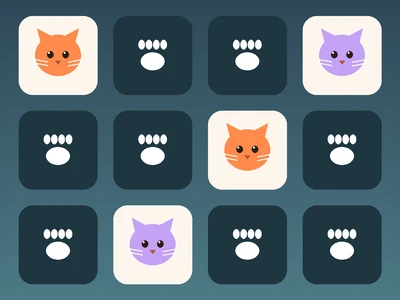
10. Paw print puzzle
Deduce where the cat walked from the prints it left. Core mechanic: logical deduction. Hard part: generating puzzles with exactly one solution, which is a genuinely difficult constraint-satisfaction problem.
Choosing one to build
- Pick the one with the clearest single verbIf you cannot state the player's action in three words, the scope is already too large.
- Build the verb before anything elseGet the cat moving and the core interaction working. If that is not fun with placeholder rectangles, art will not save it.
- Add one failure conditionNot three. One clear way to lose is enough for a small game and keeps the feedback legible.
- Add a score lastYou cannot decide what to reward until you know how the game actually plays.
- Cut everything you were unsure aboutA small finished game beats a large unfinished one every time.
Key Takeaways
- A workable small-game idea has one verb you can state in three words.
- Build the core interaction with placeholder shapes before any art at all.
- One clear failure condition keeps feedback legible; three muddies it.
- Decide the scoring model last, once you know what the game rewards.
- Every idea here has a specific hard part - knowing it in advance is most of the planning.
Frequently Asked Questions
Are you going to build these?
Possibly some of them. They are published here because ideas are cheap and finished games are not.
Can I use these ideas?
Yes. Game mechanics are not owned, and there is nothing proprietary about any of them. The specific games on this site are our own implementations.
What is the smallest viable browser game?
One input, one obstacle type, one failure condition and a score. That is genuinely enough if the interaction is good.
How long does a small browser game take to build?
A focused weekend for something like Cat Hop if you already have a game loop. Longer if you are also building the engine.
Do I need to be good at art?
No. Every visual on this site is drawn from rectangles, ellipses and paths. Shape language matters far more than drawing ability.