Game Mechanics
How Random Number Generation Works in Arcade Games

Players tend to assume arcade games are full of randomness. They are not. Randomness appears in a few specific places, it is almost never uniform, and in several games it is deliberately absent.
Where randomness is actually used
| Use | Example | How constrained |
|---|---|---|
| Which obstacle type | Cat Dash | Weighted, and the weights shift with distance |
| Gap and spacing values | Cat Hop, Midnight Cat | Bounded by what a full jump can clear |
| Which pattern comes next | Cat Obstacle Rush | Chosen from a pool of authored, play-tested sequences |
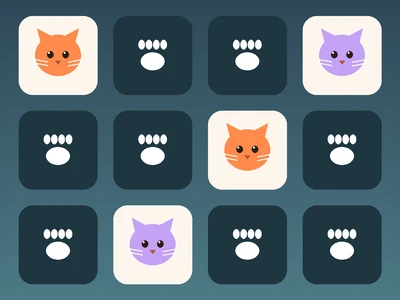
| Card layout | Cat Memory Match | A genuine shuffle - the one place uniform randomness is correct |
| Sequence steps | Cat Paw Pattern | Uniform among four pads, which is the whole game |
| Cosmetic variation | Every game | Unconstrained, because nothing depends on it |
The pattern is consistent: randomness is unconstrained only where the outcome does not affect fairness. Anywhere a value could make the game impossible, it is bounded.
Why uniform randomness is usually wrong
Uniform means every option is equally likely, which sounds fair and usually produces a worse game.
Consider obstacle types. Uniform selection means the hardest obstacle appears just as often in the first five seconds as in the third minute - so a new player meets the toughest thing in the game before they have learned the basic one. Weighted selection, with weights that shift as the run progresses, produces a game that develops.
Uniform selection also produces clumps. Genuine randomness is streaky: flip a coin twenty times and long runs of the same result are common. In a game, three identical obstacles in a row reads as a broken generator even though it is perfectly random.
Why real randomness feels unfair
People are poor judges of randomness. We expect it to look evenly distributed, and it does not - genuine randomness clusters. A player who meets the same obstacle four times running will conclude the game is picking on them, and no amount of correctness in the code changes that perception.
The common response is to constrain the randomness in ways that make it feel more random: refuse to repeat the same choice more than twice in a row, or reduce an option's weight after it has been chosen. The result is less random and feels more so.
Seeded randomness
A random number generator can be seeded with a starting value, and the same seed produces the same sequence. This is useful for two things: reproducing a bug exactly, and letting two players attempt an identical layout.
The games here do not use seeding - every run is different, and there is no shared-seed mode. It is worth knowing the technique exists, because "daily challenge" features in other games are usually seeded generation with the date as the seed.
Where randomness is deliberately absent
Several things players assume are random are not, and knowing which is a genuine advantage.
- Beetle patrols in Jungle Kitty follow a fixed path at a fixed speed. One observation tells you the entire cycle.
- Disappearing platforms in Magic Cat Adventure fade on a fixed timer with a phase offset. They never vary.
- Obstacle patterns in Cat Obstacle Rush come from an authored pool. The order is random; the contents are not.
- The speed curve in every runner is entirely deterministic - it depends only on distance travelled.
This matters practically. Anything deterministic can be learned, and learning is much faster than reacting.
Why memory games are the exception
Cat Memory Match is the one game here where genuine uniform randomness is exactly right. A shuffle that favoured certain layouts would make the board partly predictable, which would undermine the entire point of a memory game.
The standard approach is a Fisher-Yates shuffle, which produces every possible ordering with equal probability. It is one of the few places in game development where the naive intuition about randomness is the correct implementation.
Key Takeaways
- Randomness in arcade games is almost always bounded by what the character can do.
- Uniform selection is usually wrong: weights that shift with progress produce a game that develops.
- Genuine randomness clusters, which players read as unfair, so generators often reduce repetition deliberately.
- Much of what feels random is deterministic - patrol paths, platform cycles and speed curves can all be learned.
- A card shuffle is the one place where uniform randomness is exactly the right answer.
Frequently Asked Questions
Is the game picking on me with the same obstacle?
Genuine randomness clusters more than people expect, so streaks are normal. Most generators here also weight their choices, which changes the distribution.
Can I predict what comes next?
Partly. Spacing rules, weight shifts and authored pattern pools are all learnable even when the specific choice is not.
Do these games use seeded randomness?
No. Every run generates fresh, and there is no shared-seed or daily-challenge mode.
Is the card shuffle really random?
Yes - it uses a standard shuffle that produces every ordering with equal probability. Anything else would undermine a memory game.
Why do some things never vary?
Because determinism makes them learnable. Patrol paths and platform cycles are fixed precisely so that observation is rewarded.