Tips & Strategy
Cat Dash Beginner Tips

Cat Dash has exactly two actions and a speed that climbs steadily. That means there is very little to learn and a fair amount to get right. These are the seven adjustments that move most players from thirty-second runs to two-minute ones.
1. Use the first thirty seconds properly
The opening is deliberately gentle so you can settle, and most players spend it on autopilot. Do not. This is where you set your jump timing for the whole run, and timing established while relaxed holds up much better later than timing improvised under pressure.
2. Press earlier than feels right
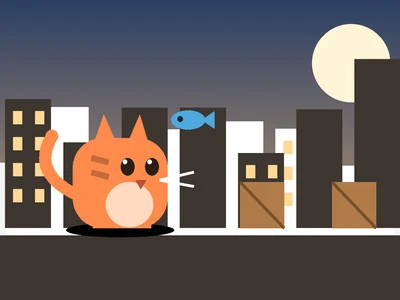
The single most valuable adjustment. By the time a crate looks like it is at jumping distance, your reaction and the cat's launch have already eaten part of the window. Press when the crate crosses the right-hand third of the canvas rather than when it feels close.
3. Duck whenever you are unsure
Ducking costs nothing. There is no penalty for being low when you did not need to be, and the cat stands up the moment you release. The only thing ducking cannot save you from is a ground crate, which is also the easiest obstacle to identify - solid, brown, on the floor.
Awnings are striped and attached to the buildings at head height. They cannot be jumped. If you find yourself jumping into one repeatedly, the fix is to default to ducking whenever the obstacle is not obviously on the ground.
4. Treat the double jump as insurance
You get one extra jump while airborne. Players who use it routinely stop improving, because it resets the fall and makes every landing slightly unpredictable. Keep it for the specific situation it was built for: you jumped early, you can see you will land short, and you need one more hop.
5. Skip the greedy fish
A fish just past a tall crate is usually a fine target. A fish immediately before one is a trap - taking it puts you in exactly the wrong place to jump. The multiplier is worth building, but a run that ends at forty seconds with a high multiplier scores less than a three-minute run with none.
The arithmetic is worth doing once. A fish at the top of the combo is worth 125 points. A typical good run is worth several thousand. A fish that ends one run in ten is costing you far more than it pays.
6. Stop watching the score
The score sits above the canvas rather than painted on the play area, specifically so you can ignore it while running. Every glance at it is attention taken from the right edge of the screen, where all the information you need is arriving. Check it when the run ends.
7. Stop when you get worse
Performance degrades with fatigue and then stays degraded. Ten focused runs beat forty tired ones, and the tired ones are actively harmful because they reinforce sloppy timing. When three runs in a row end sooner than your recent average, stop for a bit.
What a realistic progression looks like
| Stage | Typical run | What is limiting you |
|---|---|---|
| First few runs | 20-40 seconds | Still learning which obstacle is which |
| After a session | 60-90 seconds | Jump timing at moderate speed |
| After several sessions | 2 minutes plus | The transition from reaction to anticipation |
Key Takeaways
- Set your jump timing deliberately during the gentle opening thirty seconds.
- Press earlier than instinct suggests - the window is smaller than it looks.
- Duck by default when unsure; ducking has no cost and awnings cannot be jumped.
- Keep the double jump for rescuing a mistimed jump, not as part of your rhythm.
- Refuse any fish that forces a bad jump. Long runs beat high multipliers in this scoring system.
Frequently Asked Questions
How do I duck in Cat Dash?
Hold Arrow Down on a keyboard, or hold the lower half of the game area on a touch screen. The cat stays low while you hold.
Why did I die when I ducked?
Ducking passes under overhead awnings but does nothing against ground crates. If the obstacle was a solid block on the floor, it needed a jump.
Can I use the double jump twice?
No - one extra jump per airborne period. Further presses are ignored until you touch the ground.
Do fish make the game harder?
Only if you chase them. They are placed mostly on the natural jump arc, so taking those costs nothing. The ones off the arc are optional risk.
Is there an end to Cat Dash?
No. It is an endless runner - the run ends when you hit something, and the goal is distance and score.