Beginner Guides
Endless Cat Games Explained

An endless game has no finish line. There are no levels to unlock, no story to progress, and no point at which you have completed it. That sounds like it should be unsatisfying, and the format has proven remarkably durable - which is worth understanding.
What makes a game endless
- Generated content. There is no fixed layout to run out of; the game creates what comes next as you play.
- Rising difficulty within a run. The curve guarantees the run ends, which is what stops it being an endurance test.
- A score instead of a goal. One comparable number replaces the finish line.
- An instant retry. Failure costs a few seconds, so trying again is a reflex rather than a decision.
Why it works without an ending
The finish line is replaced by your own previous score. That turns an open-ended activity into a series of attempts at a specific target, which is considerably more motivating than "see how long you last".
It also means the game's entire difficulty range is available in every attempt. Nothing is locked, nothing is held back, and a new player has already seen everything the game will ever do - just not for very long. That is a different relationship from a level-based game and it suits short sessions much better.
The endless games here
| Game | Form | Score | Suits |
|---|---|---|---|
| Cat Dash | Side-scrolling runner | Distance and fish | Anyone starting out |
| Cat Hop | One-tap charged jumping | Blocks and perfects | Short breaks, phones |
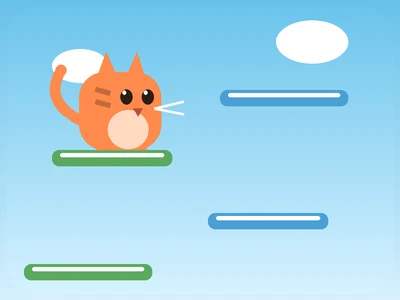
| Kitty Jump | Vertical climb | Height | Players who dislike reaction pressure |
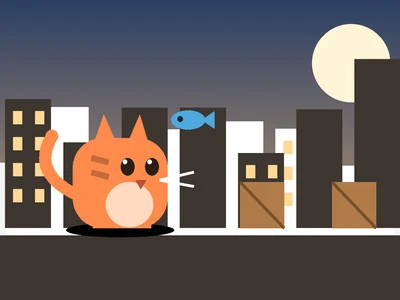
| Midnight Cat | Rooftop runner | Distance and bottles | Players who want judgement, not rhythm |
| Cat Chase | Lane switching | Distance times streak | Reaction players |
| Cat Obstacle Rush | Pattern survival | Time and stars | Players who like learning patterns |
How endless games stay fair
This is the part that separates a good endless game from a bad one. Generated content must never produce an impossible situation, and the mechanisms are specific.
- Spacing derived from live speed. The minimum gap is calculated from how far the character travels during a jump at the current speed, so reaction time never drops below a floor.
- Forbidden combinations. Pairings requiring contradictory actions are refused outright rather than left to probability.
- Bounded variation. Every generated value is capped as a fraction of what the character can do.
- A grace period. The opening seconds are empty so you are never killed before settling.
Why difficulty approaches a ceiling
Unbounded speed sounds like an elegant way to guarantee runs end. It produces a bad game: past a certain point nobody can respond to anything, so every run finishes at roughly the same place regardless of skill, and the score stops discriminating between players.
A ceiling fixes it. Past that point the challenge becomes sustaining concentration rather than coping with ever-faster input, and long runs become a test of consistency - which is a more interesting thing to be good at.
How to play them well
- Use the gentle opening deliberately - it is where your timing for the whole run is set.
- Watch where new information enters, not the character.
- Refuse collectibles that are off your route; the run is worth far more.
- Expect a plateau where reaction stops being enough, and work on anticipation rather than speed.
- Stop when three runs in a row end sooner than your recent average.
Key Takeaways
- Endless games replace a finish line with your own previous score, which is a more specific target than it sounds.
- The full difficulty range is available in every attempt - nothing is locked or held back.
- Fairness comes from spacing derived from live speed, forbidden combinations and bounded variation.
- Difficulty approaches a ceiling so that endings stay meaningful and scores keep discriminating.
- The plateau every player hits is the transition from reaction to anticipation.
Frequently Asked Questions
Do endless games ever end?
Only when you make a mistake. There is no completion state, which is what makes the score the goal.
Is there a maximum score?
Not a designed one. In practice the difficulty ceiling and human concentration set a practical limit.
Why do endless games get faster?
Rising speed shrinks your reaction window, which makes a game with unchanging rules become gradually harder and guarantees every run ends.
Can the generator produce something impossible?
Not in a properly built game. Spacing and variation are bounded by what the character can do at the current speed.
Which endless game is easiest to start with?
Cat Dash for a conventional runner, or Cat Hop if you want one button and no reading.