Beginner Guides
The Best Types of Cat Arcade Games to Play Online

"Best" depends entirely on what you want from the next three minutes. A game that is perfect when you want something to concentrate on is the wrong choice when you want something to unwind with. This guide sorts cat arcade games by what they actually ask of you, so you can pick deliberately instead of clicking around.
We have not ranked them, because ranking genres against each other is meaningless. Instead, each section explains what the type does well, what it does badly, who it suits, and which game here is the clearest example.
Quick answer: pick by situation
| If you want... | Play this type | Start with |
|---|---|---|
| Something in under a minute | One-tap | Cat Hop |
| A classic score chase | Runner | Cat Dash |
| Something you can stop and think in | Adventure platformer | Jungle Kitty |
| Something you cannot lose | Collection or memory | Fish Collector |
| A genuine challenge | Precision platformer | Magic Cat Adventure |
| To use your head, not your reflexes | Puzzle | Cat Paw Pattern |
1. One-tap games
The most restricted format, and for that reason the most immediately playable. There is exactly one input. Everything you can express has to be expressed through when you press it and how long you hold it.
What one-tap games do well is remove every barrier between opening the page and playing. There is nothing to read, no control scheme to learn, and no difference between the phone version and the desktop version. What they do badly is variety - once you understand the single mechanic, the game can only get faster or tighter, not deeper.
The example here is Cat Hop, where hold length controls jump distance and a visible meter shows exactly how far you are about to go. It is the only game on the site where the mechanic is fully explained by a single glance at the screen.
Suits: anyone with a spare minute, anyone on a phone one-handed, anyone who does not want to read instructions.
2. Endless runners
The cat moves forward automatically; obstacles arrive faster over time. Runners are the backbone of the arcade format because they do one thing very efficiently: they make a single skill - timing - progressively harder until you fail, and they do it on a curve you can feel.
The strength of the format is how quickly it produces tension. Thirty seconds into a run, the speed is high enough that you are genuinely concentrating. The weakness is that a runner asking only one thing of you becomes repetitive, which is why good ones add a second decision.
Cat Dash adds ducking to jumping. Cat Chase replaces timing with lane choice and puts a pursuer behind you. Cat Obstacle Rush uses authored patterns instead of random spawns, so recognition matters as much as reaction. All three are runners; none of them plays the same way.
Suits: people who want a score to beat, short sessions, and the specific satisfaction of a run that goes better than the last one.
3. Vertical climbers
A sub-family of platformers worth separating out, because they play so differently. The cat bounces automatically and you only steer sideways. Height is the score, and the camera never scrolls back down, so every platform you leave is gone forever.
The clever part of the format is that removing the jump button makes the game harder rather than easier. You cannot wait for the right moment, because the moment arrives whether you are ready or not. All your thinking has to be done in advance.
Kitty Jump is the example, with four platform types introduced gradually and a screen that wraps horizontally - a detail most new players never use and experienced ones rely on constantly.
Suits: people who find reaction-based games stressful but still want a score chase. Climbers are more about planning than reflexes.
4. Adventure platformers
Hand-designed levels with a beginning, an end, and checkpoints in between. This is the type that most resembles a traditional video game, and the only type here where you can stop, look at a section and work out what it wants before committing.
The advantage of hand-designed levels is precision: because a person played every jump, the difficulty can be exactly what the designer intended. A generated level has to be safe for every possible arrangement, which means it can never be as sharp. The disadvantage is length - there is a finite amount of it, and once you have finished, you have finished.
Jungle Kitty is the accessible version: four levels, no special moves, no time limit. Magic Cat Adventure is the demanding version, built around a mid-air dash that several crossings absolutely require.
Suits: people with ten minutes rather than two, and anyone who prefers solving a section to surviving one.
5. Collection games
Score comes from gathering rather than surviving, and the pressure comes from a clock rather than a threat. This is the friendliest arcade format - in a well-built collection game you cannot actually lose, which changes the feeling of playing it completely.
The skill is routing. With fish falling at different speeds in different places, the question is never 'can I reach that one' but 'is that one worth the time it costs, given what else is falling'. It is closer to planning a route around a supermarket than to reacting to a threat.
Fish Collector runs for exactly sixty seconds, has a combo multiplier that rewards not dropping anything, and puts crabs in the pond that cost you the multiplier rather than the round.
Suits: people who want arcade pacing without the failure, and anyone playing with a child.
6. Puzzle and memory games
The only type here where thinking longer helps. No reflex is being tested, and in both of our examples there is no time pressure at all on your input.
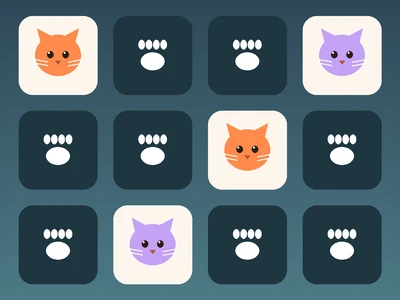
A pairs game like Cat Memory Match is a search problem: the skill is looking systematically rather than randomly, and encoding what you see well enough to use it. A sequence game like Cat Paw Pattern is a working-memory problem, and it becomes substantially easier once you group the sequence into chunks rather than trying to hold it as a list.
Suits: late evenings, playing with someone else watching, and anyone who bounces off timing-based games.
How to pick between two you like
When two games appeal equally, three questions usually settle it.
- How long do you actually have?A runner fits in ninety seconds. An adventure level does not - starting one with five minutes available means stopping halfway, which is the least satisfying way to play it.
- Do you want to concentrate or unwind?Runners and precision platformers demand attention continuously. Collection and memory games let you think at your own pace. Choosing the wrong one for your state is why a game sometimes feels annoying rather than fun.
- Do you mind failing?Some days a sudden game over is the appeal and some days it is not. Fish Collector and Cat Memory Match are the two games here that cannot end badly.
Key Takeaways
- There is no best type - there is a best type for your available time and current mood.
- One-tap games have the lowest barrier to entry; runners have the fastest route to real tension.
- Vertical climbers reward planning rather than reflexes, which suits players who dislike reaction pressure.
- Hand-designed adventure levels can be sharper than generated ones, because a person played every jump.
- Collection and memory games have no fail state, which makes them the right choice when you do not want to be interrupted by losing.
Frequently Asked Questions
Which type of cat game is easiest?
One-tap games, by a clear margin. There is a single input and a visible meter showing what it will do. Cat Hop is playable within seconds of the page loading.
Which type is hardest?
Precision platformers. Magic Cat Adventure asks you to time a mid-air dash to about a third of a second on several crossings, on top of variable-height jumping.
What should I play with a young child?
Cat Memory Match on the small board, or Fish Collector. Neither can be lost, neither requires reading, and both work with single taps.
Are runner games or platform games better?
They test different things. Runners test timing under pressure; platformers test spatial judgement and let you think. If you find runners stressful, that is a reason to try a platformer, not a reason to give up.
Which type works best on a phone?
One-tap and collection games. Both need simple inputs that touch handles well. Precision platformers are playable on touch but genuinely easier with a keyboard.
How many types should I try before deciding?
Three, ideally from different families - a runner, a platformer and a puzzle game. They are different enough that liking one tells you almost nothing about the others.