Beginner Guides
What Are Cat Arcade Games? A Complete Beginner's Guide

A cat arcade game is a short, skill-based game with a cat as the player character, usually played in a browser. A round lasts one to four minutes, the rules are visible within seconds, and the thing you are competing against is your own previous attempt. That is genuinely the whole definition - everything else is variation.
The term gets used loosely across the web, often for anything with a cat in it. This guide sets out what actually distinguishes the genre, what the main types are, how they are scored, and where to start if you have never played one.
Where the word "arcade" comes from
The word is inherited from coin-operated cabinet machines, and the design constraints of those machines are why the genre looks the way it does. A cabinet had to attract a passer-by in a few seconds, teach itself with no manual, and end the round soon enough that the next person could pay. Those three pressures produced a specific shape of game: immediately legible, quick to fail, and designed so that failing makes you want to try again rather than stop.
None of those pressures apply to a browser game - nobody is queuing, nothing costs anything - but the shape turned out to be worth keeping. A game you can understand in five seconds and finish in two minutes is exactly what suits a browser tab.
The four things that make a game an arcade game
If a game has these four properties, it is an arcade game regardless of its subject, its art style or where you play it.
- A single, visible rule set
- You can work out what the game wants from watching it for a few seconds. There is no inventory, no stats screen, no story to follow. In Cat Hop the entire rule is 'hold to jump further', and that is legible before you have pressed anything.
- Difficulty that rises inside one session
- Arcade games get harder as a round goes on, not as you unlock things. Start a new round and you are back at the beginning of the curve. This matters because it means the game's whole difficulty range is available to you immediately.
- A definite, quick end
- Rounds end - by collision, by running out of time, or by finishing a board. They end soon enough that starting again is a small decision.
- A single number that summarises the attempt
- Score, distance, height, survival time, moves used. One number, comparable to your last one. This is what turns a short game into something you keep coming back to.
Why cats
The cat is not decoration. It does specific work.
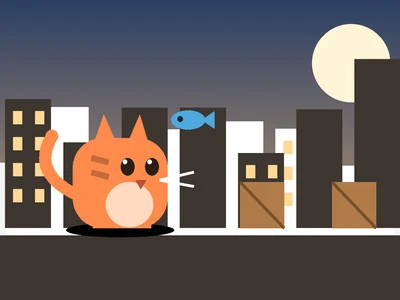
First, it removes tutorial text. A player who sees a cat on a rooftop with a gap ahead of it already knows the goal. Nobody has to write 'press space to jump to the next building'. In a game that has a few seconds to make itself understood, an instantly readable character is worth more than any amount of onboarding.
Second, cat movements map neatly onto arcade verbs. Pouncing is a jump. Chasing is a collection mechanic. Squeezing under furniture is a slide. Landing on its feet is forgiving physics. A designer choosing a cat gets a move set that players will find plausible whatever they do with it.
Third - and this is the honest part - cats are something a lot of people simply enjoy looking at. For a site meant to be a pleasant place to spend three minutes, that is a legitimate reason on its own.
The five types you will actually meet
Cat arcade games sort into five families. The art varies wildly between games in the same family; the skill being tested does not.
1. Runners
The cat moves forward automatically and obstacles arrive at rising speed. You control timing, not direction. This is the largest family and the easiest to start with, because there is only one thing to think about. Cat Dash is the plainest example: jump the crates, duck the awnings, and keep doing it while everything speeds up.
2. Platformers
You control where the cat goes as well as when it jumps, and the level layout is the challenge. Platformers come in two shapes: vertical climbs like Kitty Jump, where height is the score, and hand-designed level-based games like Jungle Kitty, where there is an actual end to reach.
3. Collection games
Score comes from gathering things efficiently rather than from surviving. These are usually timed rather than lethal - in Fish Collector you cannot lose at all, you simply have sixty seconds and a pond full of falling fish to prioritise. The skill is routing: deciding which fish is worth the walk.
4. Free-movement arcade games
The cat moves in two dimensions with no gravity and no forced direction, dodging hazards and collecting things. Space Cat is the example here. These test spatial awareness rather than timing, and they feel noticeably different from everything else because you are never forced into an action.
5. Puzzle and memory games
The challenge is recall or reasoning rather than execution. Cat Memory Match is a pairs game with no fail state; Cat Paw Pattern asks you to repeat a growing sequence. These are the games to open when you want something that will not end abruptly.
How scoring works, and why it is never just points
Every arcade game needs a number, but the number is chosen to encourage a particular way of playing. Understanding which number a game uses tells you how to play it.
| Scoring model | What it rewards | Example |
|---|---|---|
| Distance or time survived | Consistency over a long run | Cat Dash |
| Height reached | Upward progress only - no farming possible | Kitty Jump |
| Collectibles with a multiplier | Sustained accuracy without mistakes | Fish Collector |
| Distance multiplied by a streak | Clean play rather than survival alone | Cat Chase |
| Moves used, lower is better | Method rather than speed | Cat Memory Match |
A multiplier in particular changes behaviour: it makes a long clean run worth disproportionately more than a long messy one, which is precisely the point. There is more on this in understanding score systems in arcade games.
What you do not need
Cat arcade games in a browser require nothing beyond a browser. Specifically, you do not need:
- A download or an installer. The game is a web page.
- An account, an email address or a password.
- A plugin. Flash-era plugins are long gone; these games use HTML5 Canvas, which every modern browser has built in.
- A powerful device. A game drawing a few dozen shapes per frame runs comfortably on a phone several years old.
- An internet connection after the page has loaded, for most games. Once the page and its script are in your browser, the game itself runs locally.
Choosing your first one
- If you want the fastest possible startPlay Cat Hop. One button, no reading required, and you will understand the whole game within three attempts.
- If you want the classic arcade experiencePlay Cat Dash. Two actions, a rising speed curve, and the clearest example of what a runner is.
- If you dislike things ending abruptlyPlay Cat Memory Match or Fish Collector. Neither has a fail state.
- If you want something with a destinationPlay Jungle Kitty. Four hand-designed levels with an actual end, checkpoints and no time pressure.
- If you want a real challengePlay Magic Cat Adventure - but play Jungle Kitty first, because it teaches the movement this game assumes you already have.
A note on what these games are not
You will find claims across the web that casual games train your brain, improve reaction time or sharpen memory. We do not make those claims. Establishing something like that properly requires research we have not done, and repeating someone else's unsourced version of it would be worse. These are games. They are fun, they are short, and that is what we are offering.
Key Takeaways
- A cat arcade game is short, immediately legible, rises in difficulty within a single round, and ends with one comparable number.
- The cat is a design shortcut: players already know what a cat can do, so the game needs almost no tutorial.
- There are five families - runners, platformers, collection games, free-movement games, and puzzle/memory games - and they test genuinely different skills.
- The scoring model tells you how a game wants to be played. Multipliers reward clean runs; height-based scoring makes farming impossible.
- Nothing needs installing. Modern browsers run these games natively with HTML5 Canvas.
Frequently Asked Questions
Are cat arcade games only for children?
No. The format was built for adults dropping a coin into a machine, and the skill ceiling on a good runner is high. The games are suitable for children because they contain no violence, purchases or chat - not because they are aimed only at them.
Do I need to download anything to play?
No. These are web pages. The game code arrives with the page and runs inside your browser.
Are cat arcade games free?
Every game on this site is free with no account. Elsewhere, treat any site asking you to install something to play a browser game with suspicion.
What is the difference between an arcade game and a casual game?
Considerable overlap, but arcade games specifically have rising difficulty within a round and a definite failure state. Many casual games have neither - a match-three puzzle with unlimited moves is casual but not arcade.
Why do arcade games get harder as you play?
Because a game with a fixed difficulty either ends immediately or never ends. Rising difficulty guarantees each round concludes while letting a skilled player go further, which is what makes the score meaningful.
Can I play cat arcade games on my phone?
Yes, and many suit phones better than computers. A one-button runner maps perfectly to a tap, and games here include touch controls designed for each game rather than a generic on-screen pad.